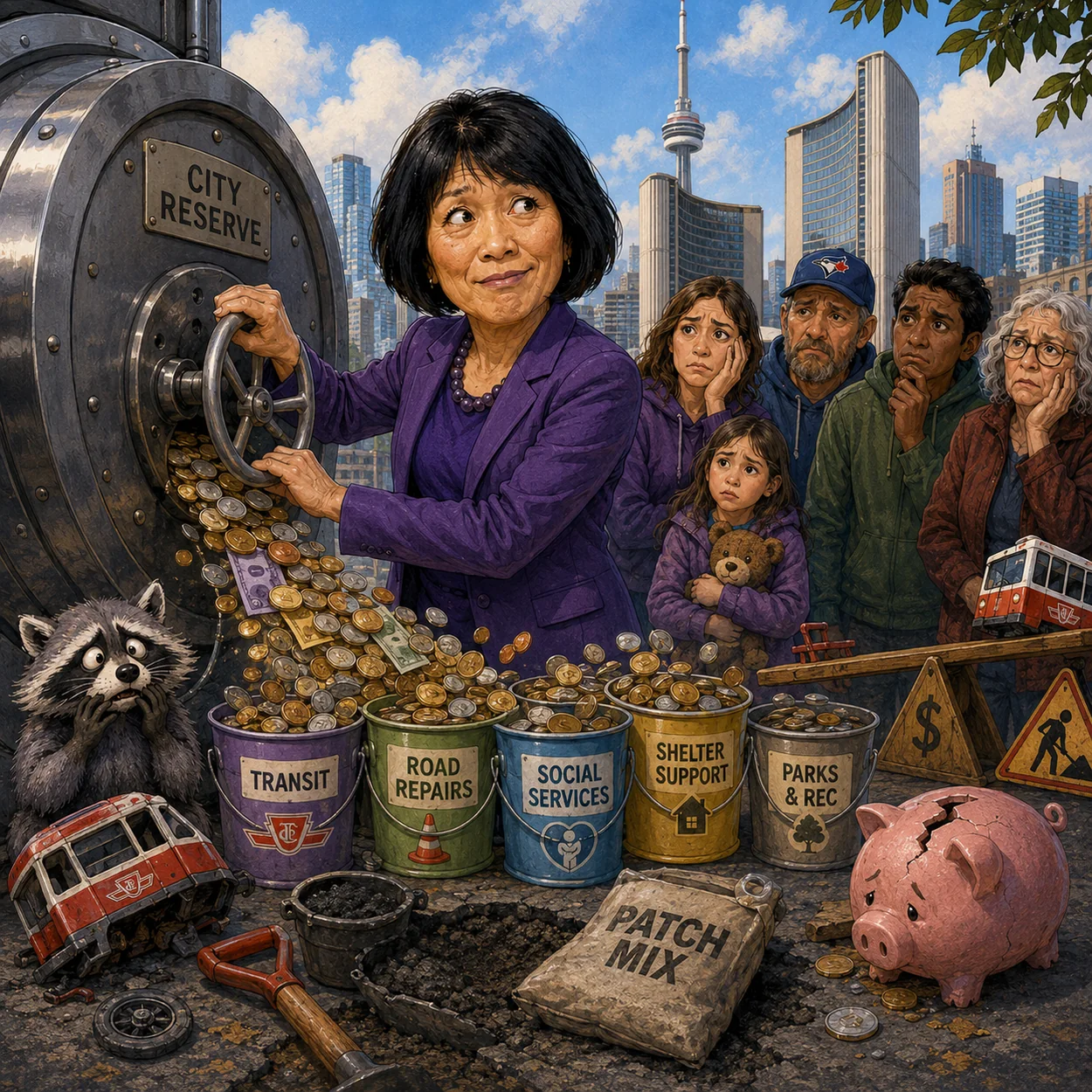
The City’s adopted funding table lists $1.73 billion in withdrawals from reserves and reserve funds for the $18.86 billion operating budget. The combined residential property-tax and City Building Fund increase was 2.2%.
What the public record establishes
The City presented the budget as an affordability and service-stability plan supported by the Ontario–Toronto New Deal, efficiencies, reductions, offsets and reserve funding. Separate reserve documents show inflows as well as outflows and projected balances over several years.
Election-year fiscal contrast: the final 2026 budget used a 2.2% combined residential property-tax and City Building Fund increase. Its $18.86-billion operating funding table includes $1.73 billion in withdrawals from reserves and reserve funds. The useful accountability question is how much recurring spending relies on one-time sources—not whether all reserve use is inherently improper.
Who controlled what
Municipal authority and responsibility
The mayor controlled the proposed budget and its political priorities under the strong-mayor budget process. Council could amend within the statutory process. Staff supplied financial forecasts and reserve schedules.
Inherited or external context
Reserve withdrawals are not automatically irresponsible. Reserves exist for stabilization, planned programs, capital purposes and one-time pressures. A gross withdrawal number is not the same as a net permanent depletion, and different reserve accounts have different restrictions.
What Chow said or did
Chow emphasized the lowest residential increase of her term, affordability measures, fare policies, service stability and improved intergovernmental support. Critics argued that one-time funding can postpone rather than solve structural pressures.
Accountability analysis
The responsible critique is sustainability, not a simplistic claim that $1.73 billion vanished. Readers should compare operating outflows, contributions, projected balances and the extent to which recurring expenses rely on one-time sources.
Claims this article does not make
Do not add differently defined annual tax percentages without explaining the method. Do not call all reserve withdrawals “raids.” Separate gross withdrawals, inflows and net balance changes. Identify whether a reserve use is planned, restricted, recurring or exceptional.
Questions to track
- How much recurring spending is supported by one-time revenue?
- What are projected operating-reserve balances for 2027 and 2028?
- Which efficiencies were permanent and independently verified?
- What tax or service pressure is forecast after election year?
Sources and evidence
- 2026 budget decision Official
- 2026 budget document Official
- Reserve briefing note Official
- Final budget news release Official
Source links should be rechecked immediately before publication. Secondary reporting is used for context; official records control where they conflict.